John Bartholomew – The Imperial Map
Among the earliest of major cartographic works of John
Bartholomew II (1831-1893) was his engraving of the Imperial
Map of England & Wales, published in 1868. Although originally printed
on 16 sheets covering England and Wales from north to south[1]
it was not long before both county and regional maps were being prepared from
the plates. Archibald Fullarton was the publisher of the Imperial Map and it
was issued both in book format and as
separate sheets (from which it would be possible to form a wall map).
Shortly after the Imperial Map first appeared both W H Smith
and A & C Black were offering copies of the same sheets under their own
imprints. Black’s offered a New Large Map of England & Wales in 16
sheet. About 1890 W H Smith offered the Cyclist’s Road Map of England &
Wales in 16 sheets from the Ordnance Survey. In addition Houlston and Wright, later Houlston & Sons, were offering various maps
of Devon taken from the Imperial Map plates.
The Thorough Guides series published by Dulau and Co. from 1888 onwards (see B&B 157 and
separate entry) was the first work to make extensive use of the plates to
produce sectional maps of Devon and Cornwall. Towards the end of the century updated
transfers were taken to produce excursion maps and local guide maps for other
publishers such as G W Bacon & Co., Charles Pearson, Houlston & Wright
and Abel Heywood (see below), Varnan Chown & Co. (1903)[2].
and Darlington (1908)[3] and maps in The Royal Atlas of
England and Wales (circa 1900) originally came from the Imperial Map and for cyclists small pocket sized county maps from this atlas were prepared for the Pattisons (see Victorian Maps of Devon entry 175) . G W Bacon seems to have been cooperating with John
Bartholomew in the early 1900s and copies of the full county map appeared with
Bacon’s typical covers: eg Bacon's County Map of Devonshire with parts of adjoining counties from circa
1905 until the 1920s.
Click the entry below to go directly to the map(s) in question:
Bartholomew Imperial Map 1 - See below
Bartholomew Imperial Map 2 - W H Smith´s Exeter and Environs / Plymouth & Dartmoor
Bartholomew Imperial Map 3 - maps published by Houlston & Wright / Houlston & Sons
Bartholomew Imperial Map 4 - maps used by Milligan etc. for guides to Ilfracombe
Bartholomew Imperial Map 5 - hunting maps for Hiorns & Miller
Bartholomew Imperial Map 6 - The Royal Atlas
Bartholomew Imperial Map 7 - Abel Heywood´s guide to Ilfracombe
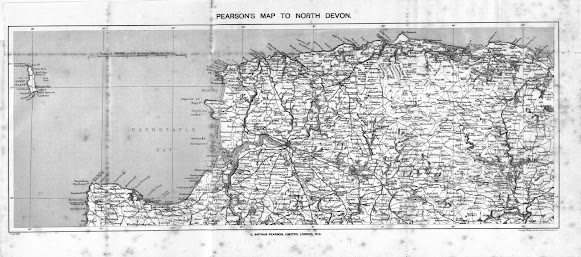
Bartholomew Imperial Map 8 - Pearson´s Gossipy Guide
In addition Bartholomew produced two further maps of South Devon for W H Smith:
Bartholomew - W H Smith 1
Bartholmew - W H Smith 2
Bartholomew Imperial Map 1a
Size: 460 x 680
mm. SCALE 4 MILES TO AN INCH (12 = 75 mm).
No title but IMPERIAL MAP OF ENGLAND & WALES (AaOS).
Imprint: A FULLARTON & CO. LONDON
& EDINBURGH (CaOS). Engraver's signature: DRAWN & ENGRAVED BY JOHN BARTHOLOMEW, F R G S. (EeOS). Sheet
number: SHEET 15 (EaOS). Elaborate
border left side only. Scale below map (BeOS). Grid B-L horizontally and Z-f
vertically.
Map covers a large area of the
county: south Wales at top and complete north coast of Devon and Cornwall as
far as Trevose Head and Somerset to Watchett; everything west of Sidmouth and
north of Dawlish is included. Railways are consistent with a date of 1865-66: to
Exmouth, Moreton, Launceston and Bideford with planned lines to Bude,
Ilfracombe (erroneously via Bittadon) and Dartmoor Loop with the stretch to
Sampford Courteney as completed. Illustrated above.
1. 1868 The Imperial Map of England &
Wales
London. Fullarton
& Co. (1868). KB
(boxed set), KB (Atlas).
2. 1870s No
title but BLACK’S NEW LARGE MAP OF
ENGLAND & WALES (AaOS). New imprint: PUBLISHED BY A & C BLACK, EDINBURGH. Folds into green covers
with title label on cover: BLACK’S NEW LARGE
MAP OF ENGLAND & WALES.
Black’s
New Large Map Of England & Wales.
Edinburgh. A
& C Black. (1870). KB.
3. 1892 No
title but REDUCED ORDNANCE MAP OF
ENGLAND & WALES (AaOS). No imprint. Folds into blue covers with title
below and small index map on cover. Coast from Padstow
and Dawlish in south to south coast of Wales. Note that the N in county name
(DEVON) is missing and that railway lines from Holsworthy to Bude and
Barnstaple to Lynton have not yet been added.
Cyclist’s
Road Map of England & Wales
London. W H Smith &
Son. (1892). KB.

Bartholomew Imperial Map 1b
Size: 235 x 680
mm. No
scale.
No title and no imprint.
Engraver's signature: DRAWN &
ENGRAVED BY JOHN BARTHOLOMEW, F R G S. (AeOS). Sheet number incomplete: SHE (EaOS). Elaborate border left and
bottom sides only. No scale. Grid C-L horizontally (letters in circles) and f-h
vertically.
Map covers all of the county
missing southwards from 1a above: all of south Devon and Cornwall below
Tavistock. Railways are consistent with a date of 1865-66: to Ashburton and
Kingswear as well as line from Plymouth to Penzance, however, Kingsbridge is
included (not built until 1890s).
1. 1868 The
Imperial Map of England & Wales
London. Fullarton &
Co. (1868). KB
(boxed set), KB (Atlas).
2. 1870s No
title but BLACK’S NEW LARGE MAP OF
ENGLAND & WALES (AaOS). New imprint: PUBLISHED BY A & C BLACK, EDINBURGH. Also has SHEET 16 (EaOS). Folds into green
covers with title label on cover: BLACK’S
NEW LARGE MAP OF ENGLAND & WALES. Illustrated above.
Black’s
New Large Map Of England & Wales.
Edinburgh. A & C
Black. (1870).
KB.
[1] Actually printed on 15 full-size sheets with sheet 16 being split into three sections roughly 1/3 size, sheet 16a covering the south of Cornwall and the south of Devon - below a line from Dawlish to Padstow and the English Channel – 16b and 16c covering the English Channel south of England.
[2] Varnan, Chown & Co.s "Half-Inch To Mile“ Map Of North Devon District. Signatures: The Edinburgh Geographical Institute (AeOS) and Copyright – John Bartholomew & Co. (EeOS). 290 mm x 560 mm..Scale 2 Miles to an Inch (5=65 mm) (CeOS). Inset PLAN OF ILFRACOMBE. Railways to Lynton and Northam and planned to Appledore. Map reverse covered in adverts. Folded into yellow cardboard covers c.1903.
[3] Darlington’s Devon and Cornwall guide (c.1908) used a transfer of North Devon.